

Safe space for students to learn steady-state spectroscopy and photocatalysis techniques.
Photocatalysis setups
GC-MS system coupled with:
- KAUST closed batch reactor with top illumination window
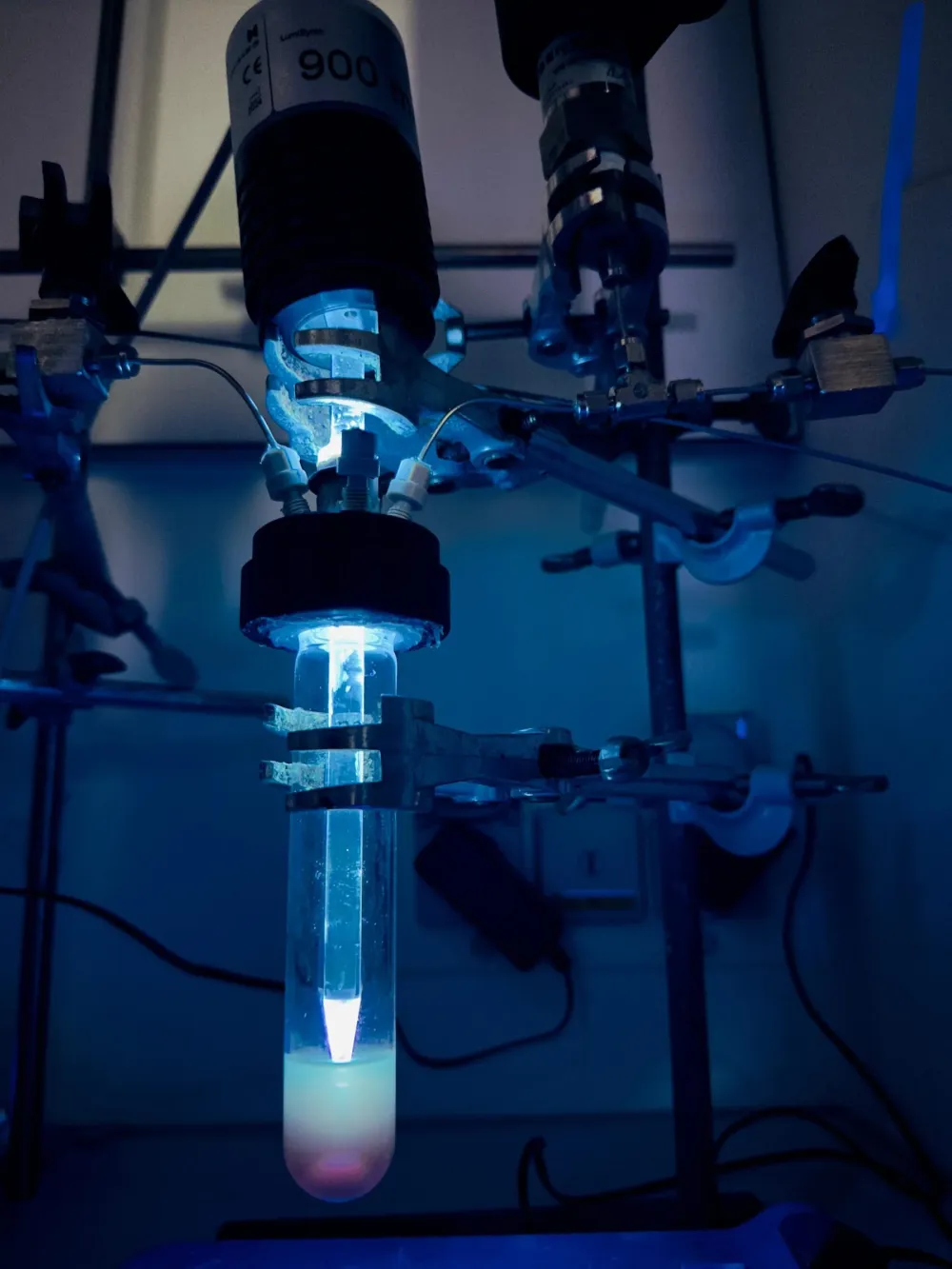
- Nevolab closed batch glass reactor with inside illumination
- Light sources: LEDs (365, 405, 450, 525 nm), AAA solar simulator
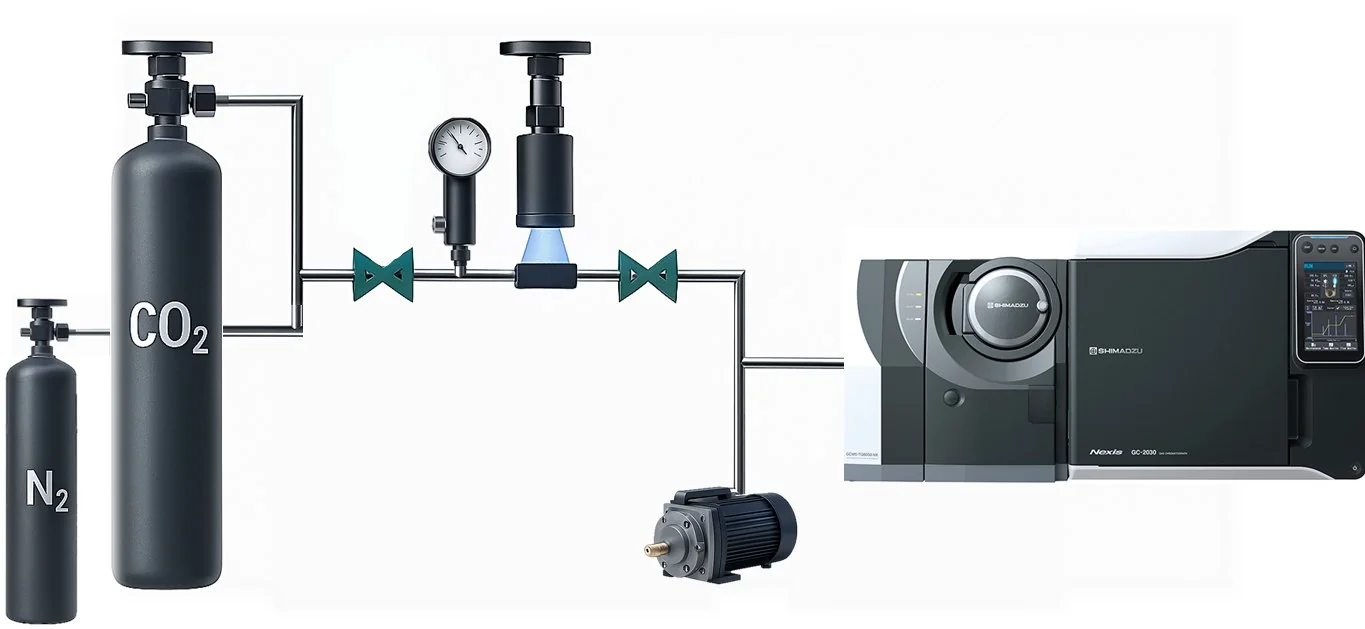
The closed batch system consists of an isolated stainless-steel or glass reactor connected to a gas chromatographer/mass-spectrometer via a transfer line. Both, automatic injection via transfer line and manual injection, are possible.
We use GC-MS Shimadzu QP2020-NX with electron ionisation (EI), which is equipped with a U-Bond column (30 m, ID 0.32 mm) for CO₂ separation and a Molsieve 5A column (30 m, ID 0.32 mm) for CO separation without N₂ interference. The system allows us to separate and quantify CO₂, C1–C6 hydrocarbons, C1–C4 oxygenated hydrocarbons (liquids and gases), as well as permanent gases. Helium is used as a carrier gas to improve the sensitivity for hydrocarbons.
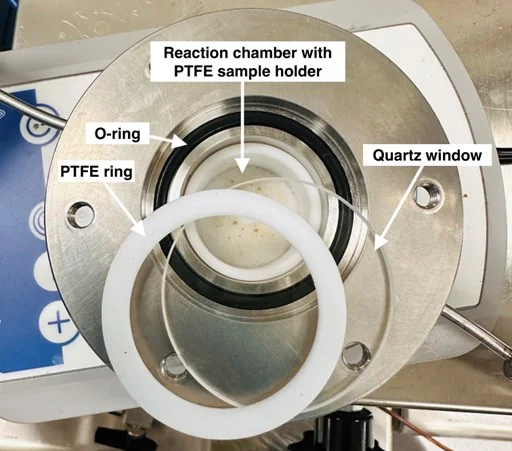
Before the CO₂ conversion reaction, the reactor is typically evacuated and purged with N₂ at least 6 times to remove air. Then the reactor is filled with CO₂ gas to a chosen pressure. During the reaction, the photocatalyst suspension is stirred and illuminated with one of the LEDs or a solar simulator. At the end of the reaction, the transfer line is evacuated to 0.1 bar before the analysis. The gas mixture is injected into the GC sample loop via the pressure drop between the reaction chamber and the transfer line. The ability to evacuate the transfer line and the sample loop prior to the analysis eliminates the possibility of contamination with air and provides a higher sensitivity for targeted analytes.
Importantly, the origin of generated CO₂ conversion products can also be easily confirmed with ¹³C-isotope labelling using our GC-MS system with ¹³C isotope labelled CO₂ gas (Sigma Aldrich, 99 atom % ¹³C, < 3 atom % ¹⁸O).
GC-TCD system:
Notably, Helium is not an optimal carrier gas for the detection of H₂ gas generated during water splitting. Therefore, the efficiency of H₂ evolution from water splitting is evaluated in a separate setup with Argon as carrier gas. In this case, quantitative and qualitative analysis is performed using Agilent GC 8860 system with a Thermal Conductivity Detector (TCD). This GC-TCD can be equipped with an HP-Molesieve column for permanent gases analysis or with an HP-5 column for the analysis of organic compounds.
Want to build a reactor yourself? The CAD drawings are available here: Make your own photocatalysis reaction chamber
Key equipment
- Photocatalysis reactors coupled with Shimadzu GCMS-QP2020 NX
- PicoQuant FluoTime 300 – TCSPC system
- FTIR-RAM Bruker Vertex 70 – RAM II
- UV/Vis/NIR spectrometer Lambda 1050 (PerkinElmer)
