

Our Research

Explore our 4 core research areas

Photophysics drives renewable energy technologies

At SPECTRE, we study various materials, including organic polymers, small molecules, covalent and metal-organic frameworks, and perovskites. While they differ in structure and chemical nature, many of these materials demonstrate similar exciton and charge carrier generation pathways, as well as loss channels - processes which occur upon light absorption. Ultrafast and steady-state spectroscopic techniques provide us with valuable insight into these mechanisms. That enables us to identify the limitations of various energy conversion systems and move toward new, highly efficient and reliable technologies. Our research brings together diverse fields so everyone can find where they belong.

Organic Photovoltaics

Organic Photovoltaics

Exploring new polymers and small molecules as photoactive layers in organic solar cells.

We investigate donor-acceptor systems and their interfaces to deepen the understanding of exciton dynamics, charge carrier generation, mobility and extraction in solar cells and solar batteries.

Key questions

  • What chemical and photophysical processes drive degradation under light, heat, and in air?
  • How can we disentangle overlapping excited-state absorption signals from various species?
  • How do molecular packing and morphology affect carrier mobility and recombination?

Recent highlights

Time-resolved Spectroscopy

Time-resolved Spectroscopy

Developing ultrafast spectroscopic techniques with fs resolution from UV to mid infrared.

We develop precise measurement setups in the sub-20-femtosecond regime. With the NOPArainbow, we have direct tunability between 380 nm and 1.6 µm with only a small gap at the fundamental. We can also access all wavelengths down to 190 nm, as well as into the MIR, with only a single nonlinear mixing process.

Recent highlights

Photocatalysis

Photocatalysis

Harnessing light to drive photoreactions for solar fuels production.

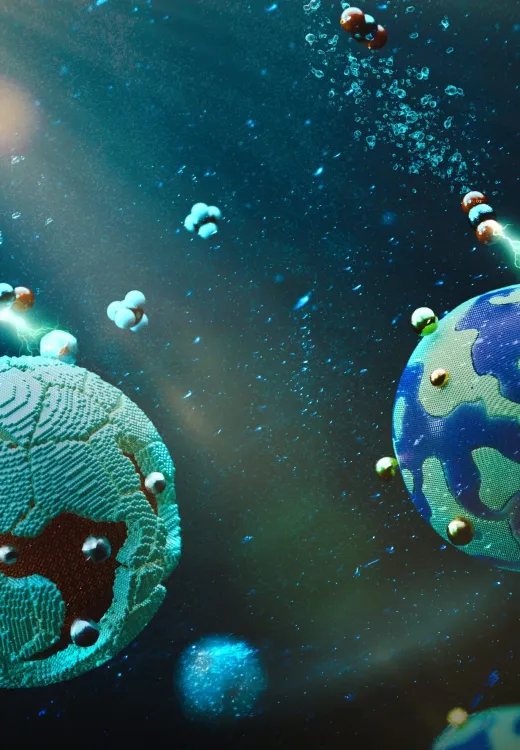
We investigate catalytic and photophysical properties of organic and hybrid photocatalysts, which drive CO₂ conversion into value-added chemicals and H₂ evolution from water. We also test catalyst stability, reaction selectivity, and investigate the effect of various reaction conditions on the reaction yield.

Key questions

  • How can we improve the utilisation of the visible-light spectrum in photocatalytic processes?
  • What limits charge carrier transfer from the catalytically active site to the reactant?
  • How does the morphology and nanostructure of a photocatalyst influence its activity and selectivity?

Recent highlights

Perovskite Photovoltaics

Perovskite Photovoltaics

Advancing high-efficiency perovskite-based solar cells for Earth and Space applications.

Our independent group leaders develop perovskite solar cell technology as a part of their ERC Starting Grant (INPERSPACE) and Emmy Noether Program.

Interested in collaborating?

We welcome joint projects, student applications, and shared instrumentation requests.