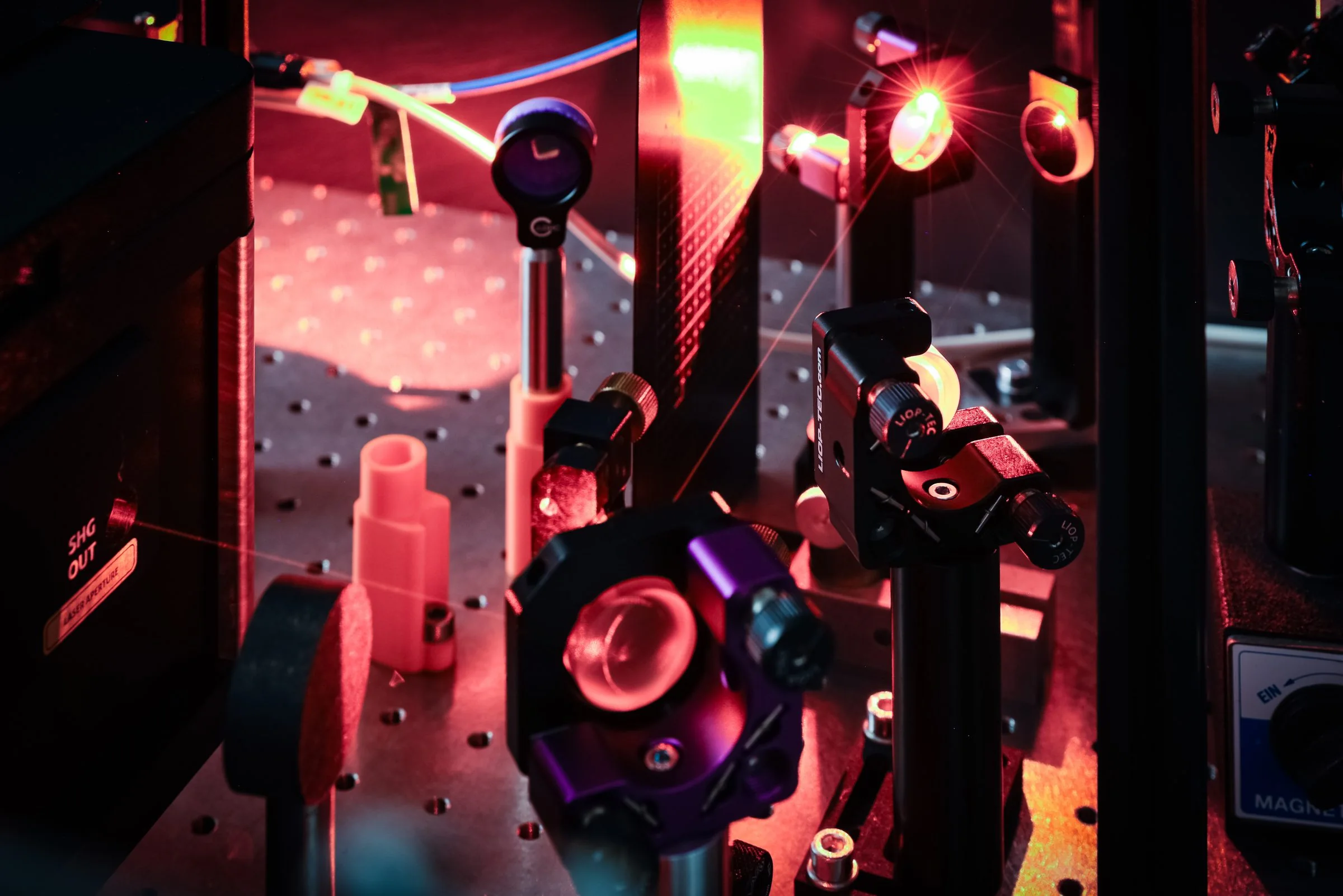
All setups are custom-built by group members and provide optical and electro-optical characterisation of PV devices and photocatalysts.
Photoinduced absorption spectroscopy (PIA)
Photoinduced absorption aims to detect the presence of photoexcited species via their specific absorption spectra. A sample is excited with a continuous-wave (CW) optical source (pump), in our case, a Cobolt-06 laser, which is electronically modulated by a Lock-in amplifier. A tuneable monochromatic probe light source (Quartz tungsten halogen (QTH) or SiN IR lamp) is then used to measure the photoinduced changes in transmission with the aid of a Lock-in amplifier and a low-noise current preamplifier.
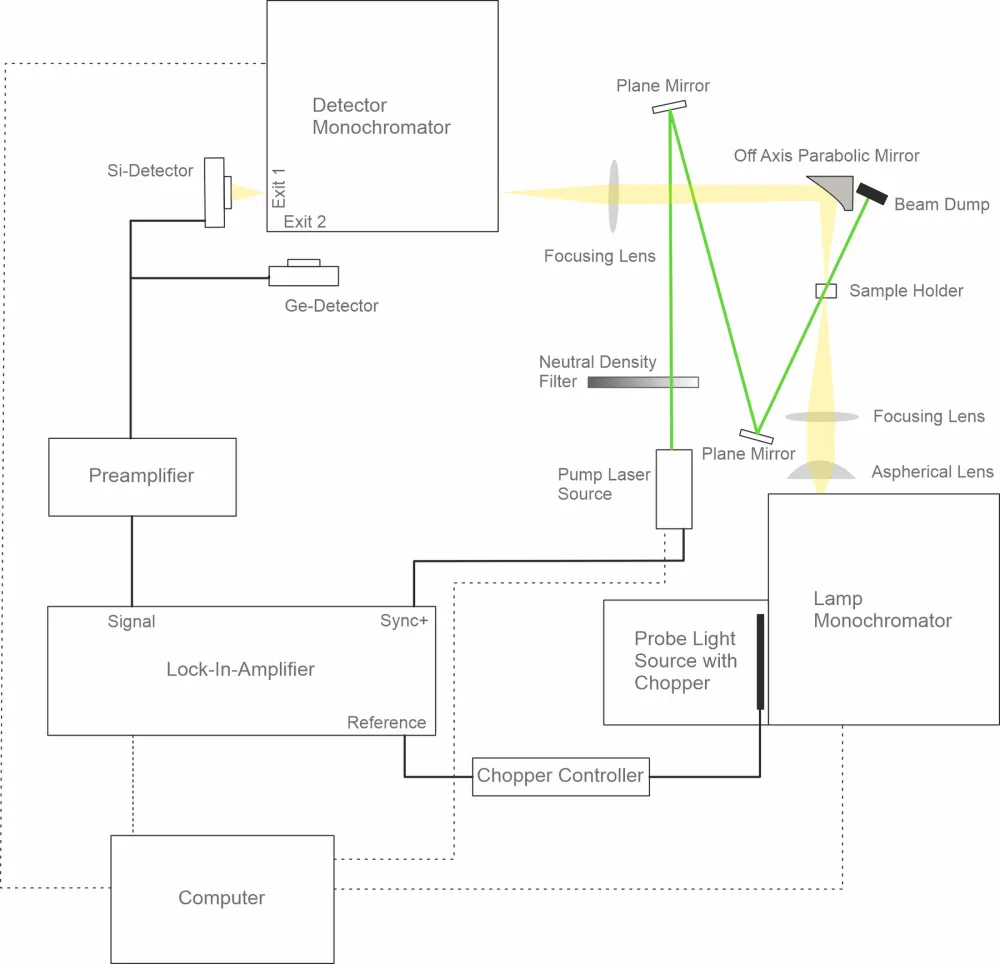
PIA measures the quasi-steady-state photoinduced population change at the pump modulation frequency and the probe photon energy, which is then scanned to construct the spectrum.
First, Transmission (T) is measured using modulated white light with a mechanical chopper (without a pump laser). Then, Photoluminescence (PL) is measured using a modulated laser pump (without probe light). Finally, the PIA+PL signal is recorded under pump-probe conditions.
The resulting ΔT/T is proportional to the modulated density of photoexcited species due to the Beer-Lambert law:
−ΔT/T (λ) = [ PIAPLx(λ) − PLx(λ) ] / T(λ)
The density of photoinduced species (signal amplitude) is a trade-off between the photoinduced generation of the absorbing species and their lifetime.
Observing the change in absorption at different wavelengths, long-lived excited species like charges or triplets can be identified. Using various detectors (Si, Ge, InSb), a broad wavelength region from 400 nm up to 5000 nm can be analysed.
PIA enables us to detect long-lived species, which can drive photo-redox reactions in photocatalysis. It can also be used for studying the materials used in organic photovoltaics.
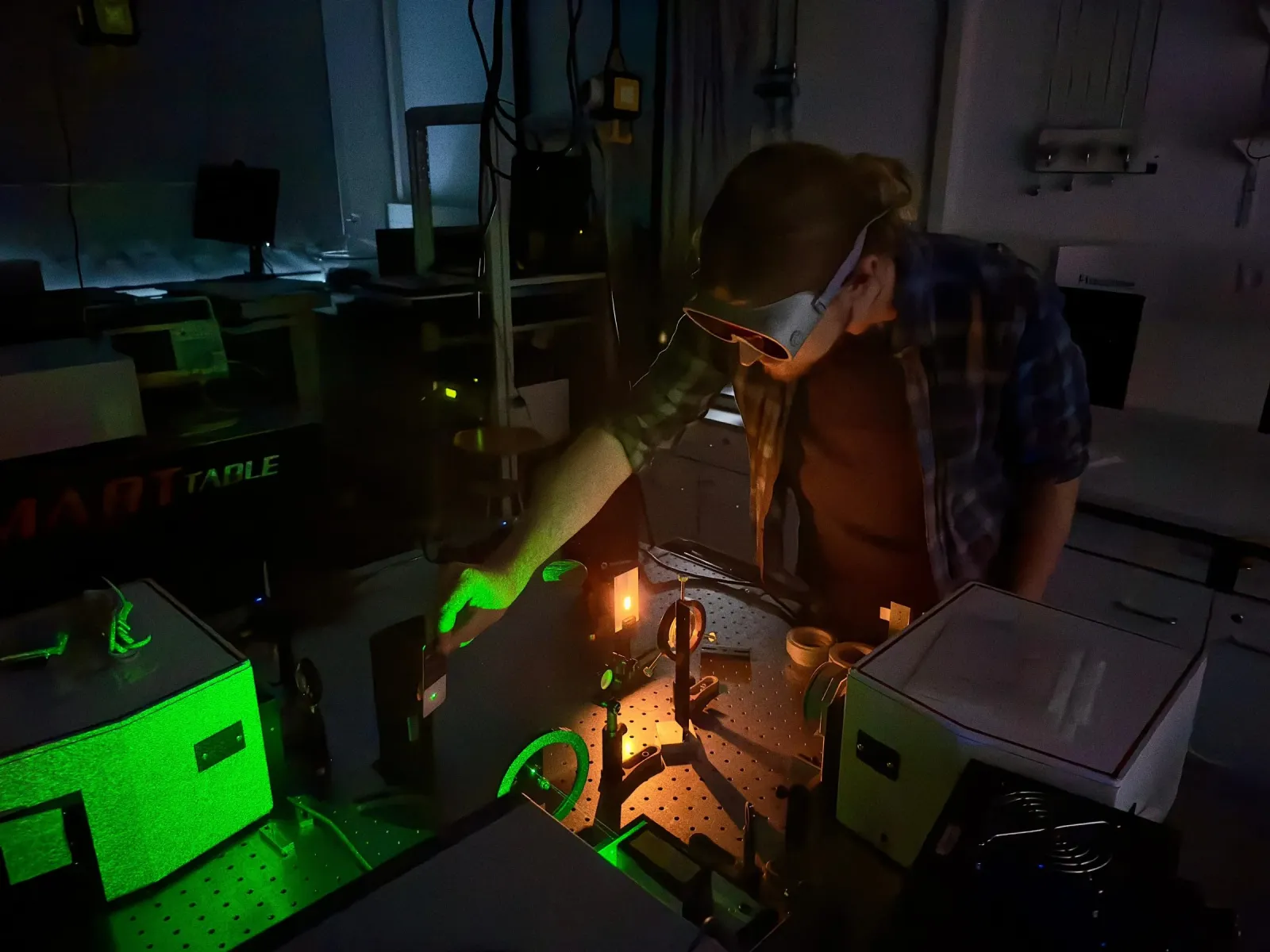
Want to build one yourself? See How to build your own PIA – with the list of components and the Bachelor's thesis for download.
Key equipment
- TRPL setup with streak and iCCD cameras, Coherent Chameleon Discovery (660–1320 nm) and Ekspla (210–2100 nm) lasers, and HarmoniXX SHG unit
- Sensitive EQE and T-dependent sEQE
- Photoinduced Absorption Spectroscopy (400 nm to 5 µm)